Charlotte Douglas International Airport Black Car Service | CLT Chauffeur Transportation
Charlotte Douglas International Airport Transportation FAQs
How early can I schedule a chauffeur to Charlotte Douglas International Airport?
Most of our early-morning CLT airport reservations begin around 6:00 AM, although we regularly accommodate earlier departures when availability permits. We have handled pickups at 4:00 AM and occasionally as early as 3:00 AM, but reservations earlier than that are generally not accepted. For scheduled airport transportation, our goal is to have the chauffeur on location approximately 15 minutes before the requested pickup time. That means a 6:00 AM reservation normally has the vehicle positioned and ready around 5:45 AM. Early-morning passengers will also find bottled water and charging cords waiting in the vehicle, which can make the beginning of a very long travel day a little easier.
How far in advance should I reserve transportation to or from CLT Airport?
We recommend reserving a Charlotte Douglas International Airport transfer at least 10 to 12 hours in advance whenever possible. Last-minute reservations can sometimes be accommodated, even late in the evening for the following morning, but availability becomes much more difficult to guarantee. Families requesting child car seats should reserve even earlier because the correct seats must be selected, installed, tightened and secured before the vehicle leaves for the pickup. Weddings, proms and other special-event transportation should generally be reserved much farther in advance rather than treated like an ordinary airport transfer.
Does 1776 Black Car Service monitor my incoming flight?
Yes. The flight number is one of the most important pieces of information we request for an airport arrival because the chauffeur monitors the flight rather than relying solely on its originally scheduled arrival time. Flights routinely arrive early, run late or experience significant delays, and Charlotte weather can occasionally suspend airport operations even after an aircraft has landed. Once we commit to an airport reservation, our responsibility is to be there when the passenger actually arrives, not simply when the airline originally said the aircraft would arrive.
What happens if my flight is delayed, canceled or diverted?
A delayed flight does not cause us to abandon a confirmed passenger. If the aircraft arrives substantially later than expected, we adjust around the actual arrival and continue monitoring it. When overlapping reservations create a conflict because one aircraft has been severely delayed, we may use another qualified chauffeur or an affiliate transportation provider so that both passengers can still be accommodated.
If an airline cancels or diverts the flight, we do not believe the passenger should be penalized for something outside of their control. The reservation can be canceled or rescheduled without treating an airline cancellation or weather disruption as though the customer simply failed to appear. We will then make every reasonable effort to accommodate the passenger’s revised travel plans.
What happens during thunderstorms or other weather delays at CLT?
Charlotte’s warm-weather thunderstorms can create unusual airport delays, particularly when lightning causes ground operations to stop. An aircraft may technically have landed while passengers remain aboard waiting for a gate or while baggage-handling operations are temporarily suspended. In situations such as these, we wait. A passenger should not be treated as responsible for additional waiting time caused by an airline, airport operational delay or severe weather event.
Where does the chauffeur meet arriving passengers for Meet & Greet service at CLT?
For domestic arrivals, our chauffeur enters the baggage-claim level and waits near the carousel assigned to the passenger’s flight while holding a name sign. Charlotte Douglas has baggage-claim areas extending across both sides of the terminal, with the main central area located between them. Flight-information monitors inside baggage claim identify the arriving flight and the carousel assigned to its luggage.
There is also an Airport Information/Welcome Center in the central baggage-claim area. That location is particularly important because it serves as our default meeting point if a passenger and chauffeur are unable to locate one another.
How are international arrivals handled at Charlotte Douglas Airport?
International arrivals require more time because passengers must clear U.S. Customs and Border Protection before entering the public portion of the terminal. Their checked luggage is handled as part of the international-arrival process rather than simply appearing on a regular domestic baggage carousel. Clearance time varies considerably. We have seen passengers emerge surprisingly quickly, while other international arrivals have required an hour or longer. The chauffeur takes this additional processing time into consideration when meeting an international passenger.
What is included with CLT Meet & Greet service?
Meet & Greet is much more than standing inside the terminal with a sign. The chauffeur can help retrieve identified luggage from the baggage carousel, assist passengers managing strollers, walkers, wheelchairs and other travel equipment, and help families or older travelers make their way through the terminal.
Baggage carts at CLT currently cost approximately $7. Passengers may obtain one directly, or we can arrange the cart when requested in advance and add the airport’s cart charge to the reservation.
After collecting the luggage, the chauffeur accompanies the passenger from baggage claim to the elevator, travels up through the terminal/deck connection and crosses the skybridge to the parking deck where the vehicle is waiting. This is one of the reasons some passengers prefer Meet & Greet over trying to coordinate a curbside pickup after a long flight.
Does 1776 Black Car Service offer curbside pickup at CLT?
Yes. Curbside pickup is available for passengers who prefer it. We generally coordinate the pickup downstairs around Zones 3 or 4 and use the middle pickup lane when airport operations permit. The chauffeur waits off-site in a designated remote waiting area while the passenger collects their luggage. Once the passenger is ready, they call or text and the vehicle proceeds to the terminal.
Accurate communication matters because CLT’s roadway system requires the vehicle to circle the airport again if the chauffeur and passenger miss one another, and another trip around the terminal loop can add roughly ten minutes during busy periods.
How do I contact my chauffeur after my flight lands?
Passengers are instructed to contact us after landing. Because we are already tracking the aircraft, we normally know that the flight has arrived before the passenger turns their phone back on. Within several minutes of landing, we can usually speak with the passenger and confirm the pickup instructions.
For curbside service, the passenger contacts us again after collecting their luggage so that we can leave the remote waiting area and proceed to the terminal. With Meet & Greet service, the process is simpler because the chauffeur is already standing near the assigned baggage carousel holding the passenger’s name sign.
What should I do if my phone dies and I cannot contact my chauffeur?
Go to the Airport Information/Welcome Center located in the central portion of the baggage-claim area. This should be considered the default meeting location whenever communication fails.
Airport personnel at the information desk can assist passengers, and announcements may be possible when necessary. We have encountered dead phones and missed connections before, and having one predetermined meeting location is much easier than having a chauffeur walk the entire baggage-claim area trying to locate a passenger.
How long will the chauffeur wait if I cannot be located?
We do not disappear shortly after an aircraft lands. Around 30 minutes without contact we begin making additional attempts to determine what has happened, particularly when the passenger should reasonably have reached baggage claim. If approximately an hour passes with no contact and we have no indication of where the passenger is, the reservation may ultimately have to be treated as a no-show.
Normal baggage delays, customs processing, airport disruptions and other situations in which we know the passenger is still working their way through the airport are different. Communication is the most important factor.
What happens if my luggage is delayed or lost?
We wait. If Meet & Greet service was reserved, the chauffeur can remain with the passenger while they speak with the airline and file a delayed- or lost-baggage report. For curbside service, the chauffeur remains in the waiting area until the passenger has completed the airline’s process and is ready to leave.
A delayed suitcase is an airline problem, not something the passenger intentionally caused, and we do not believe a customer should be abandoned simply because baggage handling took longer than expected.
How much luggage can fit in one of your SUVs?
There is no completely accurate answer based only on the number of bags because airport luggage comes in dramatically different sizes. A Yukon XL can generally accommodate approximately six medium-to-standard-size pieces of luggage comfortably under typical passenger configurations. When additional cargo room is required, the third-row seating can be folded flat, substantially increasing luggage space but reducing passenger capacity.
Golf bags deserve special mention because their long shape makes them considerably more difficult to load than ordinary suitcases. We generally load the largest and heaviest luggage first, place smaller luggage above it and keep softer duffels, laptop bags and similar items positioned where they will not be crushed.
Passengers traveling with an unusually large amount of luggage should tell us when requesting the reservation rather than waiting until the vehicle arrives.
Should I reserve an SUV or an executive van for a large family?
That decision depends on the number of passengers, child seats and amount of luggage. Our Yukon XL SUVs work very well for families and airport travelers, but passenger capacity decreases when the third row must be folded to create additional cargo space.
For larger groups, multiple child seats or unusually heavy luggage loads, our Ford Transit executive van provides significantly more room. The van can accommodate as many as 14 passengers under the appropriate configuration, although luggage requirements still have to be considered when determining the practical passenger capacity.
Can somebody else book and pay for my airport transportation?
Absolutely. Executive assistants routinely arrange transportation for executives without the passenger ever handling payment directly. Husbands and wives frequently reserve transportation for one another, and Charlotte-area families often arrange airport service for parents, grandparents or other relatives coming into town to visit.
The reservation and payment can remain with the person making the arrangements while the chauffeur communicates with the actual passenger regarding the airport pickup.
Can I request a child car seat for a CLT airport transfer?
Absolutely. Executive assistants routinely arrange transportation for executives without the passenger ever handling payment directly. Husbands and wives frequently reserve transportation for one another, and Charlotte-area families often arrange airport service for parents, grandparents or other relatives coming into town to visit.
The reservation and payment can remain with the person making the arrangements while the chauffeur communicates with the actual passenger regarding the airport pickup.
Does 1776 Black Car Service serve private aviation and FBO passengers?
Yes. Private aviation transportation is available, although it operates somewhat differently from ordinary scheduled-airline service. Private aircraft passengers frequently reserve the chauffeur on an hourly, As Directed basis because departure and arrival timing can be more flexible.
If a private aircraft arrives substantially later than its scheduled time for reasons within the travel party’s control, waiting time may apply. Genuine weather disruptions are treated differently. Private aviation passengers also commonly fly directly into the airport closest to their destination, such as Charlotte-Monroe Executive Airport (EQY) or Concord-Padgett Regional Airport (JQF), rather than flying commercially into CLT and then traveling overland.
What happens if my commercial flight arrives very late at night?
If we have committed to the reservation, a late aircraft does not automatically end the trip. A flight originally expected in the evening can sometimes arrive hours later because of weather, maintenance or airline operational problems. We monitor the aircraft and adjust.
That is an important distinction between prearranged chauffeured transportation and transportation that depends upon a nearby app-based driver deciding whether a delayed trip is still worth accepting.
How is a confirmed black car reservation different from scheduling Uber or Lyft in advance?
1776 Black Car Service operates by advance reservation rather than accepting inexpensive on-demand trips through an app. A confirmed reservation commits a vehicle and chauffeur to that passenger. We cannot simply swipe away the reservation because an aircraft landed late, the weather became inconvenient or another trip suddenly looks more profitable.
Our vehicles also operate with minimum reservation requirements. Professional chauffeured transportation is a different service model from a $15 or $40 on-demand ride. The customer is reserving the vehicle, chauffeur, preparation time and availability necessary to complete the trip as agreed.
Should I accept a ride from someone who approaches me inside the airport?
No. Passengers using prearranged transportation should only leave with the chauffeur they or their representative actually booked. If anyone approaches you unexpectedly offering transportation, do not assume they are connected with your reservation simply because they are professionally dressed or have a black vehicle.
If you are uncertain, call 1776 Black Car Service before leaving the terminal. With Meet & Greet service, look for the chauffeur holding the passenger’s correct name. With curbside service, confirm the pickup location and vehicle directly with us before entering the vehicle.
What confuses first-time visitors most about CLT Airport pickup?
Usually it is simply figuring out where to go. Charlotte Douglas is a major airport, and travelers coming from smaller airports can understandably find the terminal, baggage claim, multiple pickup zones and roadway system confusing.
That is why communication matters so much. For curbside service, we explain exactly where the passenger should meet the vehicle. For Meet & Greet service, the chauffeur comes inside and waits near the appropriate baggage carousel. If everything else fails, the Airport Information/Welcome Center in the center of baggage claim becomes the default meeting point.

History of Charlotte Douglas International Airport
Charlotte Douglas International Airport did not begin as the enormous airline hub travelers know today. Its story reaches back to the middle of the Great Depression, when Charlotte was still decades away from becoming the banking and corporate center it is now. The City of Charlotte established the airport in 1935, and Charlotte Municipal Airport opened in 1936. Much of the original construction was made possible through the federal Works Progress Administration, one of the New Deal programs created during President Franklin D. Roosevelt’s administration to put Americans back to work during the Depression. Mayor Ben Elbert Douglas Sr. was one of the strongest advocates for developing a municipal airport and believed commercial aviation would become an important part of Charlotte’s future.
The original airport looked almost nothing like present-day CLT. Three runways were constructed during the airport’s early development, including Runway 18-36, which became the foundation of the airfield that still exists today. The original north-south runway measured only about 3,000 feet long and 150 feet wide. Materials were brought to the site by railroad, and construction crews began working outward from the rail line. Over the decades, that runway would be lengthened repeatedly as aircraft became larger, heavier and faster. CLT’s history of its original runway
Eastern Air Lines and the Beginning of Scheduled Passenger Service
Eastern Air Lines became one of the earliest major airlines associated with Charlotte aviation. Scheduled airline service developed quickly as the new municipal airport gave Charlotte permanent infrastructure for commercial passenger travel. By 1940, the original north-south runway had already been extended to approximately 5,000 feet to accommodate increasingly capable aircraft. Eastern remained important to Charlotte for decades and eventually operated a hub at Douglas Municipal Airport during the 1960s. Piedmont Airlines, Delta Air Lines, United Airlines and other carriers would also become familiar names as Charlotte’s population, economy and business community expanded.
Morris Field and World War II
The airport changed dramatically during World War II. From 1941 through 1946, the federal government expanded the property for military use and established Morris Field, a U.S. Army Air Corps installation. Approximately $6 million was invested in the facility during the war years, with improvements that included paving, widening and lengthening runways so the airfield could accommodate military aircraft. Morris Field was used to train pilots, gunners and aircraft-maintenance personnel.
The airport was named Douglas Municipal Airport in honor of Mayor Ben Elbert Douglas Sr. in April 1941. Douglas served three terms as Charlotte mayor between 1935 and 1941 and is credited with helping bring commercial aviation to the Queen City. In 1982, the airport would take the name travelers know today: Charlotte Douglas International Airport. The story behind the Charlotte Douglas name. After World War II, control of the airport returned to Charlotte and commercial aviation again became its primary purpose.
The Jet Age Comes to Charlotte
A new passenger terminal opened in 1954, helping move Douglas Municipal Airport into a new period of commercial growth. During the following decades, piston-powered airliners gave way to larger turbine and jet aircraft, requiring longer runways, larger terminals and increasingly sophisticated airport infrastructure. Eastern Airlines made Douglas Municipal Airport a hub during the 1960s, while Piedmont Airlines continued expanding its presence in Charlotte. In 1964, the original Runway 18-36 was lengthened to approximately 7,787 feet so the airport could accommodate commercial jet aircraft. By that period, Eastern, Piedmont, United and Delta were among the airlines serving Douglas Municipal Airport.
Charlotte continued growing rapidly through the 1960s and 1970s, and the airport expanded with it. During the 1970s, Douglas Municipal added another parallel runway, a new air traffic control tower and additional terminal infrastructure. Those investments would become especially important after changes in federal aviation policy transformed the airline industry at the end of the decade.
Piedmont Airlines Changes Charlotte Forever
One of the most important chapters in CLT history began after Congress deregulated the U.S. airline industry in 1978. Before deregulation, the federal government exercised extensive control over airline routes and fares. Once those restrictions were loosened, airlines gained much greater freedom to develop hub-and-spoke networks. Winston-Salem-based Piedmont Airlines saw an opportunity in Charlotte.
Although Greensboro was geographically closer to Piedmont’s headquarters, Charlotte offered an airport management team willing to build the facilities necessary for a much larger airline operation. Airport engineer Jerry Orr became one of the central figures in that relationship, working with Piedmont founder Thomas Davis as the airline considered expanding its Charlotte presence. The turning point came on April 25, 1982. Charlotte opened its new terminal with 25 gates in Concourses B and C. On the same day, Piedmont established its Charlotte hub with 86 daily flights, and the airport officially became Charlotte Douglas International Airport. How CLT became a major airline hub
That combination of a new terminal and Piedmont’s hub operation fundamentally changed Charlotte aviation. The airport was no longer simply serving passengers traveling to and from Charlotte. It was becoming a major connecting point for travelers moving throughout the eastern United States and beyond.
From Piedmont to USAir, US Airways and American Airlines
Piedmont Airlines was acquired by USAir in 1989. Rather than diminishing Charlotte’s importance, the transition helped preserve and eventually expand the hub. USAir later became US Airways, and Charlotte continued developing into one of the airline’s most important connecting airports. The airport itself continued growing alongside the airline operation. New gates, concourses, baggage facilities, passenger amenities and terminal improvements were added as traffic increased. The relationship between Charlotte and its dominant airline survived recessions, airline bankruptcies, the disruption following the September 11 attacks and eventually the enormous changes brought by the COVID-19 pandemic.
US Airways ultimately merged with American Airlines, placing Charlotte within one of the largest airline networks in the world. Today, CLT serves as American Airlines’ second-largest hub and remains heavily oriented toward connecting traffic.
From a Small Municipal Airport to a Major Global Aviation Center
The transformation is remarkable. What began in the 1930s as a relatively small municipal airport with three basic runways has become one of the busiest airports in the world for aircraft movements. The City of Charlotte continues to own and operate CLT, while decades of construction have produced a vast complex of runways, taxiways, concourses, parking structures, roadways and passenger facilities.
The passenger terminal that opened in 1982 still forms the foundation of today’s airport, but nearly every part of it has evolved. Concourses have been expanded, baggage facilities have grown, parking decks and rental-car facilities have been added, roadway systems have been rebuilt and the terminal lobby itself has undergone an enormous transformation. One of the most significant recent projects was the Terminal Lobby Expansion, completed in 2025. The $608 million project added approximately 175,000 square feet of new space and renovated another 191,000 square feet. It also brought major changes to security screening, baggage claim, elevators and escalators, passenger circulation and the terminal’s curbside experience. CLT Terminal Lobby Expansion
Charlotte Douglas has therefore grown alongside Charlotte itself, but its enormous scale cannot be explained by population growth alone. Early city investment, World War II expansion, Eastern Air Lines, airline deregulation, Piedmont’s decision to establish a hub and the later evolution from Piedmont to USAir, US Airways and American Airlines all helped transform CLT into an airport far larger and busier than most cities of Charlotte’s size would ordinarily require.
Nearly nine decades after construction began, traces of the airport’s earliest history still remain on the modern airfield. The original north-south runway has been repeatedly rebuilt and extended rather than simply disappearing, while new runways, taxiways, terminals and passenger facilities continue to reshape Charlotte Douglas for another generation of travelers.
Charlotte Douglas International Airport Today
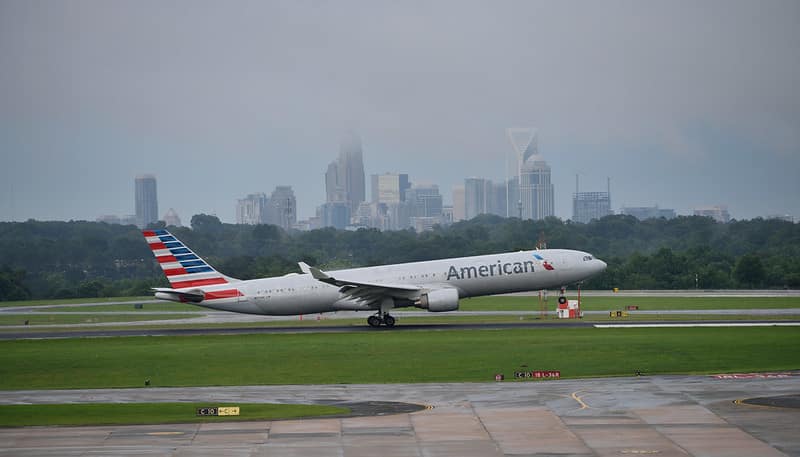
Charlotte Douglas International Airport has grown far beyond its beginnings as a municipal airport serving a relatively small Southern city. Today, CLT is one of the busiest aviation facilities in the United States and one of the most active airports in the world when measured by aircraft arrivals and departures. In 2025, Charlotte Douglas handled approximately 53.6 million passengers, making it the second-busiest year in the airport’s history after the record-setting 58.8 million passengers who traveled through CLT in 2024. The airport also recorded 574,193 aircraft operations during 2025, which includes both takeoffs and landings, placing Charlotte among a small group of airports that routinely handle more than half a million aircraft movements every year.
That level of activity works out to roughly 1,570 aircraft takeoffs and landings on an average day, although the actual number varies by season, airline schedules, weather conditions and major travel periods. Airports Council International placed Charlotte Douglas seventh in the world for aircraft operations in its preliminary 2025 rankings, while CLT also ranked among the busiest North American airports for overall passenger activity. These numbers help explain why someone standing near the terminal, parking decks or airport overlook can see an almost continuous movement of aircraft throughout much of the day, with arrivals approaching the airport while other aircraft taxi toward the runways for departure.
CLT Is Much More Than a Charlotte Airport
One of the most important things to understand about Charlotte Douglas International Airport is that most people passing through the terminal are not beginning or ending their journey in Charlotte. Approximately 65 percent of CLT passengers are connecting travelers, while about 35 percent begin or end their trip in the Charlotte region. That local percentage has increased substantially as Charlotte and the surrounding communities have grown, rising from approximately 26 percent a decade earlier, but connecting traffic continues to define the character of the airport.
This enormous volume of connecting passengers is why Charlotte Douglas can operate on a scale that initially seems unusual for the size of the Charlotte metropolitan area. A passenger flying between two cities hundreds or even thousands of miles from North Carolina may still change airplanes at CLT because the American Airlines route network funnels traffic through Charlotte. For local travelers, this creates access to an unusually large number of nonstop destinations, while for connecting passengers it makes Charlotte an important transfer point between cities throughout the United States and destinations in Europe, the Caribbean, Mexico, Central America and other international markets.
American Airlines and the Charlotte Hub
American Airlines is the dominant carrier at Charlotte Douglas International Airport, and CLT serves as the airline’s second-largest hub. The scale of American’s Charlotte operation is one of the principal reasons the airport handles so many flights every day, with banks of arriving aircraft feeding passengers into later groups of departing flights throughout the morning, afternoon and evening. This hub-and-spoke system allows travelers from smaller cities to connect through Charlotte to destinations that might otherwise have no practical nonstop service from their home airports.
The American Airlines hub also influences nearly every aspect of airport operations, including gate usage, baggage handling, runway demand, passenger connections and the rhythm of traffic surrounding the terminal. When a large group of inbound flights arrives within a relatively short period, the concourses and connecting corridors can become extremely busy, and another large wave follows as those passengers board departing aircraft. For passengers beginning their journey in Charlotte, the size of the hub provides an extensive selection of nonstop and one-stop travel options that would normally be associated with a considerably larger metropolitan area.
More Than 190 Nonstop Destinations
Charlotte Douglas currently provides nonstop air service to more than 190 destinations around the world, giving Charlotte-area travelers access to a remarkably broad domestic and international route network. The airport is served by major airlines, regional carriers and foreign flag airlines, although American Airlines and its regional partners account for a large portion of the overall schedule.
Domestic traffic remains the largest part of CLT’s operation, with destinations such as Orlando, Dallas/Fort Worth, New York, Miami, Chicago, Tampa, Philadelphia, Phoenix, Boston and Fort Lauderdale ranking among the airport’s busiest domestic markets in 2025. International travel has also become increasingly important, and approximately 4.7 million international passengers traveled through Charlotte Douglas during 2025. London remained CLT’s busiest international destination, while Cancun, Punta Cana, Montego Bay, Munich, Toronto, Nassau, Aruba and Madrid were also among the airport’s most heavily traveled international routes.
A Growing Local Passenger Market
Although connecting traffic remains central to CLT, the growth of Charlotte, Mecklenburg County, Union County, York County and the broader Carolinas region is steadily increasing the number of passengers who actually begin their trips at Charlotte Douglas. Nearly 12 million travelers passed through TSA security checkpoints during 2025, representing the local passengers who entered the secure terminal rather than simply changing airplanes after arriving on another flight.
That growth has important consequences beyond the aircraft gates because locally originating passengers require parking spaces, rental cars, hotel rooms, taxis, rideshare vehicles, private black car service, family transportation, child car seats and other ground transportation services that connecting passengers generally do not need. The continued increase in local traffic is one of the primary reasons Charlotte Douglas has invested so heavily in its terminal lobby, security checkpoints, baggage systems, parking facilities, roadways and passenger pickup areas.
One Terminal and Five Connected Concourses
Unlike some major airports where travelers must take trains, buses or automated people movers between terminals, Charlotte Douglas operates around one interconnected passenger terminal with five concourses, A through E. Once a passenger clears security, every concourse and aircraft gate can be reached on foot without leaving the secure side of the terminal. The terminal complex contains more than 120 aircraft gates and has expanded substantially beyond the facility that opened in 1982 with only 25 gates.
The single-terminal design can be convenient for connecting travelers because there is no need to leave security or wait for transportation between separate terminal buildings, although the distances between the far ends of the concourses can be substantial. Someone arriving at the outer end of Concourse E and connecting to a flight departing from the newer portion of Concourse A can have a significant walk ahead, particularly when traveling with children, mobility limitations or limited connection time. The central Atrium and adjoining portions of the terminal function as the main crossroads where passengers moving between the different concourses eventually converge.
CLT as an Economic Engine for the Carolinas
Charlotte Douglas International Airport is also one of the most important pieces of transportation infrastructure in North Carolina and South Carolina. A recent economic study estimated that CLT generates approximately $40 billion in economic activity throughout the Carolinas, supporting businesses, employment, tourism, cargo movement, corporate travel and industries that depend on convenient access to national and international transportation. The airport alone represents a significant share of the economic impact generated by all public airports across North Carolina.
CLT is owned and operated by the City of Charlotte, but the airport operates on a self-sustaining financial model rather than depending upon the City’s general fund for its normal operating costs. Revenue generated by airline operations, parking, concessions, terminal activity, cargo facilities and other airport businesses is used to support daily operations and help finance continuing improvements. That financial structure has allowed Charlotte Douglas to continue building for future growth while maintaining its role as one of the most heavily used airline hubs in the country.
An Airport That Continues to Grow
The Charlotte Douglas International Airport that passengers use today is still changing. The massive Terminal Lobby Expansion reached completion in 2025 after adding approximately 175,000 square feet of new terminal space and renovating another 191,000 square feet, while the airport also consolidated its security operation into three numbered checkpoints and expanded baggage-handling capacity. At the same time, work continues elsewhere on the property, including renovations to existing concourses and construction associated with the airport’s fourth parallel runway.
For Charlotte residents who have used CLT for many years, the scale of this transformation is difficult to miss. Parking structures have grown dramatically, roadways have been reconfigured, the front of the terminal has been rebuilt, new gates have opened and large portions of the passenger experience have changed while the airport has remained continuously operational. Even with those improvements, Charlotte Douglas remains a working hub that processes tens of millions of passengers and hundreds of thousands of aircraft movements every year, which means congestion, weather, airline scheduling and peak travel periods will always influence how quickly passengers can move through the airport.
For travelers using Charlotte Douglas International Airport transportation, understanding the scale of CLT helps explain why planning a ground transportation pickup involves much more than simply choosing an arrival time on a reservation form. Flight tracking, baggage claim, international customs processing, terminal pickup zones, changing airline schedules and heavy roadway traffic can all affect when a passenger is actually ready to leave the airport, which is why professional prearranged airport transportation must be coordinated around the passenger’s real journey rather than only the scheduled arrival time printed on an airline ticket.
Understanding the Charlotte Douglas International Airport Layout
Charlotte Douglas International Airport can feel intimidating to someone visiting for the first time, particularly when the terminal is busy and several arriving flights are unloading passengers at the same time. The good news is that the basic layout of CLT is considerably easier to understand once you know how the major pieces fit together. Charlotte Douglas has one main passenger terminal connected to five concourses, A, B, C, D and E, and travelers can walk between every aircraft gate after passing through security. There are no trains, trams or shuttle buses required to travel between the concourses, which makes CLT different from many other large American hub airports where passengers must ride between separate terminal buildings.
The central portion of Charlotte Douglas acts almost like the hub of a wheel, with the different concourses extending outward from the main passenger areas. The Atrium remains one of the most recognizable interior landmarks at CLT and serves as an important crossroads for passengers moving between different sections of the airport. Nearby areas such as The Plaza, the A/B Connector and the D/E Connector help tie the concourses together while also providing restaurants, stores, seating areas, airline lounges and passenger services. Once a traveler understands where the Atrium sits in relation to the concourses, navigating Charlotte Douglas becomes much easier.
The Main Terminal at Charlotte Douglas International Airport
The public side of the CLT terminal is divided primarily between the Departures and Ticketing Level and the Arrivals and Baggage Claim Level. Passengers beginning a trip normally enter on the upper departures level, where airline ticket counters, baggage check facilities and access to the security checkpoints are located. Passengers completing a trip in Charlotte eventually make their way downstairs toward baggage claim, ground transportation and the airport exit.
Because Charlotte Douglas is such a large connecting hub, many of the people walking through the concourses never enter either ticketing or baggage claim. A connecting passenger may arrive at one concourse, walk through the Atrium or one of the connectors and board another aircraft without ever leaving the secure side of the airport. This is one reason CLT can process tens of millions of passengers while the baggage claim area, although busy, does not receive the full volume represented by the airport’s annual passenger totals.
For travelers beginning their journey in Charlotte, all concourses and gates can currently be reached through any operating TSA security checkpoint. CLT now uses three numbered security checkpoints, and Checkpoint 2 serves as the primary TSA PreCheck location. Checkpoint availability and operating hours can change according to passenger volume, staffing and the time of day, so travelers should follow current airport signage rather than assuming the same checkpoint will always be the fastest option.
The CLT Atrium Is the Center of the Airport
The Atrium is one of the best orientation points inside Charlotte Douglas International Airport because it sits near the center of the secure passenger terminal and connects major portions of the airport together. Travelers who become turned around inside CLT can often regain their bearings simply by finding their way back toward the Atrium and then following the overhead signs toward the appropriate concourse.
The area is much more than a hallway between gates. Restaurants, shops, passenger services and seating surround the Atrium, and it regularly becomes one of the busiest parts of the airport during major connecting periods. Travelers moving between Concourses B and C naturally pass close to this central area, while passengers heading toward A, D or E can use it as a reference point before continuing through the appropriate connector.
The Atrium is also one of the places where Charlotte Douglas feels most like a major airline hub. During a large bank of connecting flights, hundreds of passengers may be walking in several directions at once, some heading toward gates and others stopping for food, checking flight information or trying to determine how much time they have before their next departure. For a first-time visitor, slowing down for a moment and reading the overhead signs can save considerably more time than continuing in the wrong direction.
Concourse A at Charlotte Douglas International Airport
Concourse A is located on the western side of the secure terminal and has expanded significantly over the years. The modern Concourse A complex includes the original gate area as well as newer gates reached through the A Connector. On the current terminal layout, the concourse extends through gate ranges beginning with the lower-numbered A gates and continuing into the newer A20 and A30 gate areas, giving this side of CLT a much larger footprint than it once had.
Unlike Concourses B, C and much of E, which are strongly associated with American Airlines and its regional operations, Concourse A serves a broader mix of airlines. This makes it an important part of CLT for passengers traveling on carriers other than American, although gate assignments can always change and passengers should rely on their boarding pass and current airport flight information.
The newer portions of Concourse A are spacious and more contemporary than some of the older sections of Charlotte Douglas, with additional restaurants, retail stores, charging areas and passenger amenities. Someone connecting from the far end of another concourse should allow enough walking time because traveling from the outer portions of Concourse E to the newer end of Concourse A can involve a substantial walk through the terminal.
Concourse B
Concourse B extends away from the central terminal near the Atrium and is heavily associated with American Airlines operations. Its current gate layout runs through the B gate series, and passengers traveling through this concourse will find restaurants, retail locations, restrooms, charging areas and an American Airlines Admirals Club along the way.
For many longtime Charlotte travelers, Concourse B feels like part of the classic CLT terminal because it traces its roots to the terminal complex that opened in 1982 when Piedmont Airlines established its Charlotte hub. The concourse has been renovated and modified many times since then, but its location continues to reflect the original hub structure that helped transform Charlotte Douglas into the airport it is today.
Passengers arriving at Concourse B who are ending their trip in Charlotte follow the signs toward the terminal and baggage claim. Those making a connection remain inside security and continue toward the Atrium before turning toward the concourse containing their next gate.
Concourse C
Concourse C extends from the opposite side of the central terminal area and is another major American Airlines concourse. Its gates run through the C series and serve a steady flow of domestic passengers throughout the day. Like Concourse B, it has a straightforward linear design, which generally makes individual gates easy to locate once a traveler enters the concourse.
Passengers walking from Concourse C toward another part of the airport eventually return toward the central terminal and Atrium. Restaurants, shops, restrooms and passenger services are available throughout the concourse, and several familiar national brands are mixed with Charlotte-area food and beverage concepts.
Because Concourses B and C sit relatively close to the central portion of CLT, passengers connecting between them generally have an easier walk than travelers moving between opposite ends of the airport. Even so, busy connecting periods can slow pedestrian movement considerably, especially when several flights arrive at adjacent gates at approximately the same time.
Concourse D and International Flights
Concourse D extends from the eastern side of the terminal and is particularly important because it handles many international operations along with domestic flights. The D gates are connected to the rest of CLT through the D/E Connector and The Plaza area, which together provide restaurants, shopping, lounge access and other passenger amenities.
An important distinction exists between international departures and international arrivals. A passenger departing Charlotte for another country moves through the terminal much like a domestic passenger, although documentation requirements may differ depending on the destination and airline. International passengers arriving in Charlotte from a country without U.S. preclearance, however, must complete U.S. Customs and Border Protection processing before entering the normal public portion of the airport.
This distinction matters considerably for anyone arranging transportation from Charlotte Douglas International Airport because the scheduled arrival time of an international flight does not represent the time the passenger will actually be ready to meet a chauffeur. After landing, travelers may need to taxi to the gate, exit the aircraft, walk to the Federal Inspection Station, clear immigration, collect checked luggage and complete customs processing before entering the public arrivals area. Depending on passenger volume and the number of international flights arriving at approximately the same time, that process may be fairly quick or may take considerably longer. CLT has continued implementing technology intended to improve international arrival processing, but the actual time still varies from flight to flight.
For a professional CLT airport transportation reservation, this is exactly why the flight number is important. The chauffeur can monitor the actual aircraft movement while understanding that an international passenger may require additional time after the aircraft reaches the gate.
Concourse E and Regional Airline Operations
Concourse E is one of the largest and busiest sections of Charlotte Douglas and extends north from the eastern side of the terminal complex. It contains a large number of gates and is heavily used for regional airline flights operating under the American Eagle network. These smaller regional aircraft connect Charlotte with communities throughout the eastern United States and are an essential part of the hub system that feeds passengers into American Airlines’ larger domestic and international network.
For travelers who have never used CLT, Concourse E can seem surprisingly long, particularly when their gate is near the far end of the concourse. Passengers making a connection from a distant A gate should pay attention to their boarding time and begin walking sooner rather than assuming every CLT connection is only a few minutes away. Charlotte Douglas does not have an internal passenger train, so every connection between concourses is made on foot unless the passenger has arranged mobility assistance.
Concourse E also contains passenger amenities including restaurants, retail locations, restrooms, charging areas and service animal relief facilities. CLT maintains a post-security service animal relief area near the upper portion of Concourse E, as well as other relief areas around the airport for passengers traveling with trained service animals. (Charlotte Douglas International Airport)
The A/B Connector and D/E Connector
Two areas that frequently appear on CLT maps are the A/B Connector and D/E Connector. These names can confuse first-time passengers because they sound like separate concourses, but they are essentially connecting sections of the terminal that help passengers move between the major gate areas.
The A/B Connector provides access toward Concourse A and the B side of the terminal, while also containing restaurants, shops and passenger amenities. The D/E Connector serves a similar purpose on the opposite side of the airport, helping passengers move toward Concourses D and E while providing additional dining, retail and lounge facilities.
These connectors have become increasingly important as Charlotte Douglas has expanded because the airport is no longer simply five narrow corridors attached to a central building. New gate areas and passenger facilities have extended outward from the original terminal, creating a larger network of interconnected spaces that still remains walkable under a single secure roof.
The Plaza
The Plaza is located near the eastern side of the central terminal between the main passenger areas and the D/E side of the airport. It has become another useful landmark for travelers navigating CLT because it provides a recognizable gathering area with dining, shopping and access toward several portions of the terminal.
Passengers traveling toward Concourses D and E may pass through or near The Plaza, while those returning toward the Atrium can use the area as a directional reference. Travelers with longer connections may also choose this part of the airport for a meal or a place to sit rather than remaining immediately beside their departure gate.
We will cover Charlotte Douglas restaurants and shopping separately because the airport now has enough dining and retail options to justify its own detailed section, particularly with the mix of Charlotte-based establishments and national airport brands throughout the concourses.
CLT Baggage Claim and the Arrivals Level
For passengers whose journey ends in Charlotte, the Arrivals and Baggage Claim Level is one of the most important parts of the airport. After leaving the secure gate area, arriving passengers follow overhead signs toward baggage claim and descend to the lower public level of the terminal. The baggage carousels are arranged through the central arrivals area, and airport information displays indicate which carousel has been assigned to each arriving flight.
The baggage claim area is also where 1776 Black Car Service provides indoor Meet & Greet service for arriving passengers. When Meet & Greet has been arranged, the chauffeur enters the terminal, monitors the arriving flight and waits near the baggage carousel assigned to that passenger’s flight while holding a name sign. Once the passenger arrives, the chauffeur can assist with locating luggage, removing bags from the carousel and helping manage luggage, strollers, walkers or other travel equipment before escorting the passenger back toward the parked vehicle.
This is one reason Meet & Greet service can be particularly useful for families arriving at CLT with small children, passengers traveling with several bags, older travelers, people using mobility equipment and visitors who have never been through Charlotte Douglas before. Instead of landing in an unfamiliar airport and trying to determine which curbside zone to use while handling luggage at the same time, the passenger has a specific person waiting inside the terminal.
The Visitor Information Center as a Useful Meeting Point
One of the most useful landmarks on the baggage claim level is the Visitor Information Center, which is centrally located in the arrivals area and staffed during published airport hours. For passengers who become separated from the person meeting them, cannot determine where to go, have a dead mobile phone or simply need help finding a location inside the airport, the information center provides a practical place to ask for assistance. CLT currently lists the Visitor Information Center on the Arrivals and Baggage Claim level as one of its passenger service locations.
For 1776 Black Car Service passengers, this central location also provides a sensible backup meeting point if communication unexpectedly becomes impossible. Mobile phones usually reconnect shortly after an aircraft lands, but batteries die, calls occasionally fail and travelers sometimes miss each other in a crowded baggage claim area. Having an easily identifiable central location is considerably better than wandering from one end of the terminal to the other trying to locate one another.
From Baggage Claim to the Hourly Parking Deck
Passengers using indoor Meet & Greet service do not simply walk out of baggage claim and immediately step into a vehicle waiting at the curb. The chauffeur normally parks in the Hourly Parking Deck, walks into the terminal and then escorts the passenger back to the vehicle after the luggage has been collected.
The Hourly Deck is the closest major parking structure to the terminal. CLT currently provides terminal access through skybridges connected to the Level 5 elevator lobbies and through underground walkways connected to the Level 1 elevator lobbies. For a typical Meet & Greet pickup, the route from baggage claim involves using the elevator system, moving to the appropriate parking deck level and crossing toward the parked vehicle. This process takes longer than a simple curbside pickup, but it provides a very different passenger experience. Someone arriving with several suitcases, young children, a stroller or mobility equipment has assistance from baggage claim all the way to the vehicle instead of being expected to manage everything while searching for a car on a busy airport roadway.
Curbside Pickup at Charlotte Douglas International Airport
CLT also allows curbside pickup on the lower Arrivals and Baggage Claim Level, provided the vehicle arrives only when the passenger is ready. Airport rules prohibit vehicles from remaining unattended or waiting indefinitely along the terminal curb, which means a chauffeur cannot simply park outside baggage claim while a passenger waits twenty minutes for luggage.
For curbside reservations with 1776 Black Car Service, the chauffeur tracks the arriving flight and remains away from the terminal roadway while the passenger enters baggage claim and collects luggage. The passenger contacts the chauffeur after landing and again when ready for pickup, at which point the vehicle approaches the designated meeting area. Clear communication is important because airport traffic continuously moves through the terminal loop, and missing the passenger can require the chauffeur to circle the roadway before making another pickup attempt. CLT itself recommends that people waiting for arriving passengers use the airport’s Cell Phone Lot until the traveler has collected luggage and is ready to be picked up. The same basic principle applies to professional transportation, although a commercially licensed chauffeur follows the applicable airport transportation procedures rather than simply operating as a private vehicle.
Departures and Drop-Off at CLT
For passengers traveling to Charlotte Douglas International Airport, the process is generally simpler because the chauffeur can deliver the traveler directly to the terminal before the flight. The primary departure area is located on the upper Ticketing and Departures Level, where passengers can enter near their airline’s ticket counter and baggage check area before proceeding toward security.
CLT notes that passengers may also be dropped on the lower arrivals level during periods of heavy congestion, which can sometimes help avoid the busiest departure traffic. Once inside the terminal, passengers can reach any concourse through an operating security checkpoint, so there is no requirement to enter through a particular checkpoint simply because the flight departs from a specific concourse.
For early morning airport transportation, arriving with additional time becomes especially important because the roadway may be relatively quiet while the terminal itself is already busy with passengers checking bags for the first large departure bank of the day. A 1776 Black Car Service reservation is normally planned around a chauffeur arriving before the requested pickup time whenever circumstances allow, giving passengers some additional margin before beginning the drive to CLT.
Accessibility, Families and Passenger Assistance Inside CLT
Charlotte Douglas has continued adding facilities for passengers who need additional assistance, including accessible restrooms, family restrooms, Mother’s Rooms, universal changing stations, service animal relief areas and the Hidden Disabilities Sunflower Program. Family restrooms are distributed throughout the concourses as well as the ticketing and baggage claim areas, while Mother’s Rooms are available in multiple post-security locations.
For families arriving in Charlotte with infants or young children, understanding the airport layout before landing can make the trip considerably less stressful. Parents may already be managing carry-on bags, checked luggage, strollers and tired children before they ever reach ground transportation, which is one reason prearranged CLT airport transportation with child car seats can be useful. When the requested child restraint has been arranged in advance, 1776 Black Car Service can have the appropriate convertible seat or booster installed in the SUV or executive van according to the parent’s instructions before the vehicle arrives for the reservation.
Passengers traveling with service animals also have several relief areas available both before and after security. Current CLT locations include relief facilities in baggage claim, the A Connector, the D/E Connector and Concourse E, giving travelers options whether Charlotte is their destination or simply a connecting point.
Why Understanding the CLT Layout Matters for Ground Transportation
A flight showing “landed” on a tracking application does not mean the passenger is standing outside Charlotte Douglas International Airport ready to enter a vehicle. The aircraft still has to taxi to the gate, passengers must deplane, anyone sitting near the back of a full aircraft may wait several minutes before reaching the jet bridge, and a traveler with checked luggage must then walk to baggage claim and wait for the carousel to begin delivering bags. International passengers can require considerably more time because Customs and Border Protection processing takes place before they enter the normal public arrivals area.
This is why professional Charlotte Douglas International Airport black car service works best when transportation is coordinated around the actual flight rather than only the scheduled arrival time. A chauffeur who knows the airport layout, monitors the aircraft and understands how passengers move from the concourses to baggage claim can anticipate the difference between an aircraft landing and a passenger actually being ready to leave CLT.
For first-time visitors, the most important thing to remember is that Charlotte Douglas is a very large airport, but it is still fundamentally one connected terminal. Concourses A, B, C, D and E all lead back toward the same central passenger complex, baggage claim is located on the lower arrivals level, ticketing and departures are above it, and the Atrium provides one of the easiest landmarks for understanding the secure side of the airport. Once those basic reference points make sense, the rest of CLT becomes much easier to navigate.
For passengers using 1776 Black Car Service, the goal is not to expect someone arriving after a long flight to memorize a terminal map. The purpose of knowing the layout is to make the meeting process predictable, whether the reservation calls for an indoor Meet & Greet at baggage claim or a coordinated curbside pickup after the passenger has collected luggage. That combination of flight monitoring, airport familiarity and direct communication is what turns a very busy international airport into a manageable final step of the journey.
We have officially expanded our executive fleet options to provide comprehensive coverage south of the border into York County and surrounding communities. Whether you are coordinating a corporate SUV for an early morning business flight, arranging guest transportation for a local wedding venue, or traveling with infants using our pre-installed child car seats, we offer reliable, premium South Carolina Black Car Service and CLT Airport Transportation built completely around your schedule.
Added Service Areas
Rock Hill, SC | Chester, SC | Clover, SC | Lancaster, SC | Tega Cay, SC | York, SC | Fort Mill, SC